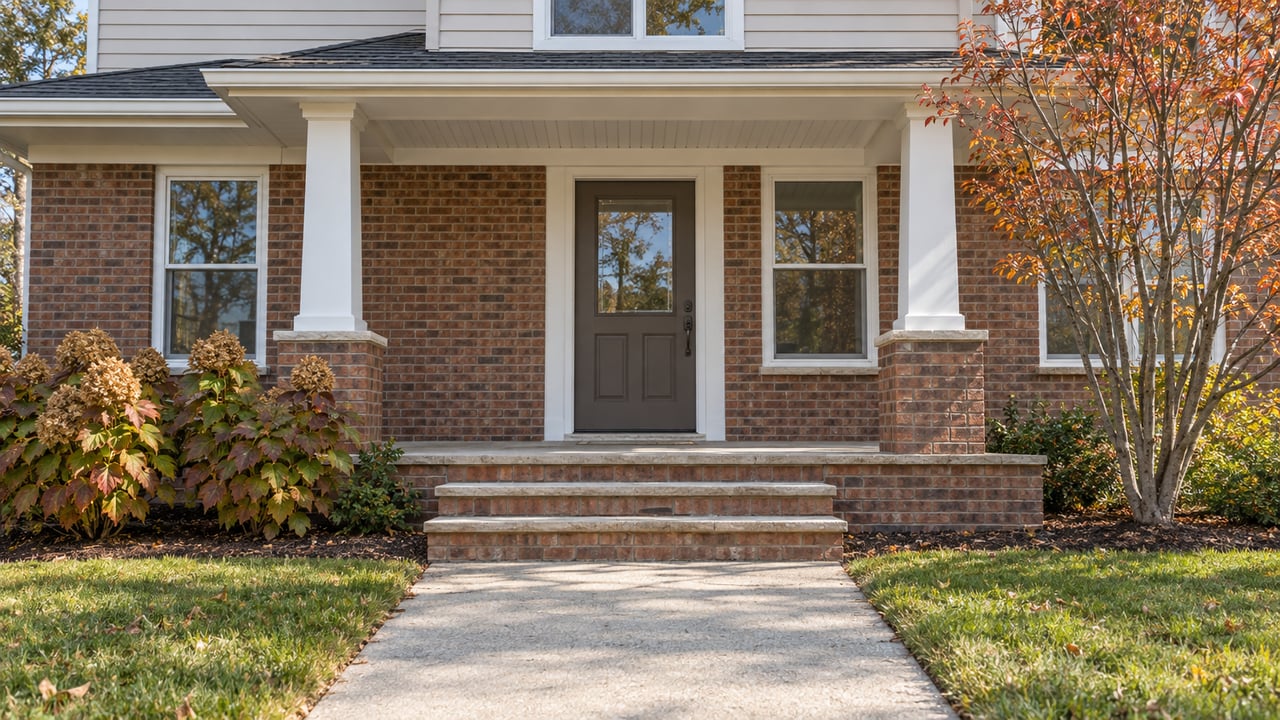
Ohio collects property taxes in arrears, as Ohio Real Title explains, so the tax figure on any listing is last year's bill. In most years that figure is close enough to plan around. This winter, the Franklin County side of the Pickerington Local School District is an exception. New property values for that side are being finalized right now, and they take effect after many buyers have already agreed on a price and a closing date.
Your seller credit at closing usually comes from that same older bill. If the old bill shows up in your budget and also sets your credit, you can have a payment gap and you won't see it until the first tax statement arrives.
How the number on the listing gets built
The math is the same in every Ohio county. Fairfield County's treasurer describes it in three steps.
- Start with the auditor's market value for the parcel.
- Multiply it by 35% to get the assessed value. The Franklin County Auditor's office says every Ohio property owner pays on 35% of appraised value.
- Multiply the assessed value by the effective tax rate for the taxing district the parcel sits in.
The first step is the one that changes this winter. The third step is why two homes a short drive apart can carry very different bills.
The county line splits the timing
The Ohio Department of Taxation's schedule puts each county on a six-year reappraisal cycle, with a lighter update three years in. Under that schedule, Franklin County has an update in 2026 and Fairfield County's next update comes in 2028.
Fairfield County. Auditor Carri L. Brown's office announced on July 10, 2025, that it had finished the state-required sexennial valuation update. Residential value notices went out that July. Homes in Violet Township and inside the city of Pickerington got their new values in that round. The next scheduled change is three years away.
Franklin County. Auditor Michael Stinziano's office released tentative 2026 values on June 9, 2026. Residential values rose 10.1% on average countywide, and all property types together rose 7.4%. The county's own breakdown gives a figure for its part of the Pickerington Local School District. There, preliminary residential values rose 7% on average, and all property types rose 5%.
This was an update year, so Franklin County worked from arm's-length sales in 2023, 2024 and 2025. It didn't do the full exterior inspection that comes with a six-year reappraisal. The 7% figure is also still preliminary. The county's review period has closed. In-person and virtual reviews ended September 5 and documents were due September 12. Final values and mailed notices are expected by mid-December 2026.
What the rate sheets show across Pickerington schools
The same school district carries at least six different effective residential rates across the two county rate sheets, depending on which county, township and municipality a parcel sits in. These are the tax year 2025 rates, which apply to bills paid in 2026, in dollars per $1,000 of assessed value.
| Taxing district | County | Effective residential rate, TY2025 |
|---|---|---|
| Madison Township–Pickerington Corporation, district 187 | Franklin | $55.359108 |
| Madison Township–Pickerington LSD, district 183 | Franklin | $51.769110 |
| Pickerington Corporation, Pickerington LSD | Fairfield | $50.953488 |
| Violet Township, Pickerington LSD | Fairfield | $49.217255 |
| Columbus–Pickerington LSD, district 540 | Franklin | $45.515500 |
| Columbus Corporation, Pickerington LSD, district 058 | Fairfield | $40.847583 |
Here's a home with a $400,000 auditor's value run through the treasurer's formula. The assessed value is $140,000. The gross annual tax before any credits comes to about $7,750 in Franklin County's Madison Township–Pickerington Corporation district, $7,248 in Madison Township–Pickerington LSD, $7,133 in Fairfield County's Pickerington Corporation district, $6,890 in Violet Township, $6,372 in the Franklin County Columbus district and $5,719 in the Fairfield County Columbus district. Those are gross numbers. The Franklin County Auditor's rate sheet and Fairfield County Treasurer's rate sheet also list non-business and owner-occupancy credits that reduce the actual bill on qualifying homes.
So two homes at the same price in the same school district can differ by well over a thousand dollars a year in gross tax. For the Franklin County rows, the value the rate is multiplied by is the one that changes this winter.
Why a 7% value increase doesn't mean a 7% tax increase
Higher values don't pass straight through to the bill. Fairfield County's auditor explains that each revaluation triggers a review of tax rates, and in general rates are adjusted downward as values rise. That's why a value increase doesn't mean a dollar-for-dollar tax increase.
Two 2025 state laws add more limits, and each one covers a specific piece of the bill.
- HB 335 tells county budget commissions to adjust inside-millage rates during a sexennial reappraisal or triennial update. The goal is to keep collections from growing faster than the cumulative inflation rate for the previous three years. Ohio House materials say this relief starts in January 2027.
- HB 186 took effect March 20, 2026. It creates an inflation-cap credit for school taxes in districts at the 20-mill floor. The Ohio Department of Taxation says the credit applies only under specific conditions in a county that is in its reappraisal or update year. It doesn't cap a homeowner's whole bill.
On the Franklin County side, then, the bill will probably move, but nobody can tell you the amount until final values are set and the 2026 rates are certified. Fairfield County's online tax estimator says it covers 2025 taxes payable in 2026 and will be updated with 2026 rates around mid-December 2026, after state certification.
Where the credit at closing can fall behind
Proration is where all of this reaches your closing statement. Ohio Real Title explains that because taxes are paid in arrears, the seller usually credits the buyer for the time the seller owned the home. The buyer then pays the full bill when it comes due.
Their worked example uses a $7,300 annual bill, which is $20 a day, and a June 1 closing. Under short proration, which assumes last year's taxes are already paid, the seller credits only the current year up to closing. That's 152 days, or $3,040. Under long proration, the count starts at the beginning of the previous cycle, July 1 of the prior year. That's 336 days, or $6,720. The purchase contract decides which method applies.
Every number in that example comes from the existing annual bill. On a Franklin County parcel during an update year, that bill reflects values the auditor is replacing. If the new values raise the tax, the credit was calculated at the old daily rate while your payments will run at the new one. Depending on the method and the closing date, the difference between those two methods can be thousands of dollars, so it pays to know which one your contract uses.
A short timeline for winter closings
- June 9, 2026: Franklin County releases tentative values.
- September 5 and 12, 2026: The informal review period ends and the document deadline passes.
- Mid-December 2026: Final Franklin County values and notices are expected, and Fairfield County's estimator is due for 2026 rates.
- January 2027: HB 335 relief begins, according to Ohio House materials.
- March 31, 2027: The Franklin County Auditor lists this as the last day to file a complaint with the Franklin County Board of Revision, including for owners who skipped the review process.
Franklin County calls the finalized values property tax year 2026. Under arrears billing, tax year 2026 is normally paid in 2027. If you close this winter on a Franklin County parcel, you'll likely be the owner when the first bill based on the new values arrives.
Questions to settle before you sign
Which county and taxing district is this parcel in? Look it up on the county auditor's site. A Pickerington Local School District label alone won't tell you which of the rates in the table applies.
Is the listing's tax figure based on pre-update values? For Franklin County parcels this winter, the answer is almost certainly yes until mid-December. Use the auditor's property search to see the tentative or final value.
Which proration method does the contract use? Ask the title company how it handles a value change that's still pending.
If you're selling on the Franklin County side and disagree with the final value, what then? You can file with the Board of Revision through March 31, 2027, whether or not you joined the fall review.
None of this is tax advice. Your own county auditor's records and tax estimator are the best source for a specific parcel.
If you're writing an offer in the Pickerington area this winter, I'm glad to pull the parcel's taxing district and current auditor value with you, and talk through how the proration terms read before you sign. Cory M Neville can help you budget for the tax bill you'll actually get. Let's Connect.